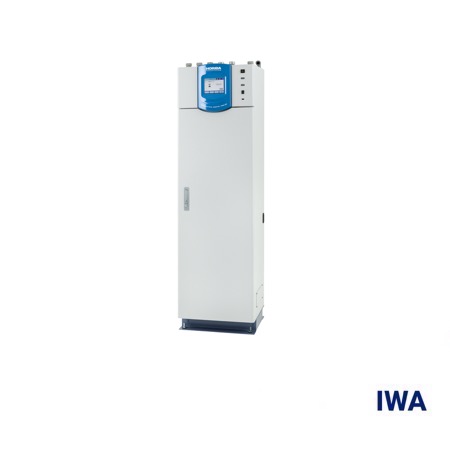
The TPNA-500 is HORIBA's latest automatic on-line monitoring system for simultaneous continuous measurement of total nitrogen (TN) and total phosphorus (TP) in wastewater and industrial effluent, designed to meet regulatory compliance requirements under Total Pollutant Load Control Systems. It uses alkaline potassium persulfate UV oxidative dissolution with UV absorption spectrophotometry for TN, and potassium persulfate UV oxidative dissolution with molybdenum blue spectrophotometry for TP. Extended 2-month reagent replacement cycles, ~30% reduced power consumption, halved pure water and waste liquid volumes, and a new contamination-resistant meniscus weighing system significantly reduce life cycle costs compared to previous models.
On order
TPNA-500, Automatic Total Nitrogen / Total Phosphorus Monitoring System, HORIBA
TPNA-500
Horiba
The TPNA-500 is HORIBA's latest automatic on-line monitoring system for simultaneous continuous measurement of total nitrogen (TN) and total phosphorus (TP) in wastewater and industrial effluent — designed to satisfy regulatory compliance requirements under Japan's Total Pollutant Load Control System and equivalent international frameworks. The latest model incorporates key improvements over previous generations: the reagent replacement cycle has been extended from one month to two months through development of more stable dedicated reagents; power consumption has been reduced by approximately 30%; pure water usage and waste liquid generation have been halved; and a new meniscus weighing method — resistant to contamination — has been adopted while maintaining the 1/10 reagent volume reduction achieved with previous models. Reduced use of mechanically driven components such as solenoid valves further improves long-term reliability. An optional third-component measurement (COD) and two-point metering capability are available for facilities requiring expanded monitoring. The system stores over one year of measurement data including daily and hourly reports, and communicates via RS-485/Modbus.
Key Features TPNA-500
- Extended 2-month reagent replacement cycle (vs 1 month on previous models) — reduced labour and consumable costs.
- ~30% reduction in power consumption; pure water usage and waste liquid volume halved — lower operating and environmental costs.
- New contamination-resistant meniscus weighing method — extended maintenance intervals and improved measurement stability.
- Reduced solenoid valve count — improved long-term mechanical reliability.
- Wide TN range: 0–2 to 1000 mg N/L; wide TP range: 0–0.5 to 250 mg P/L; repeatability ±3% FS (TN ≤50 mg N/L, TP ≤10 mg P/L) and ±5% FS (higher ranges).
- Optional 3rd-component COD measurement; optional 2-point metering for multi-location monitoring.
- Standard 4 analog outputs (4–20 mA) for TN/TP concentration and load output; 16 contact outputs; 9 contact inputs. RS-485 / Modbus communication.
- Data memory for over 1 year including daily/hourly reports, alarm history (500 events), calibration history (100 events); USB export.
- Turbidity compensation option for TN (275 nm correction wavelength).
- Compatible with older TPNA-300 and PN-100 series footprint — drop-in replacement at existing installations.
Applications
The TPNA-500 is suited to continuous automatic TN and TP monitoring at municipal wastewater treatment plants, industrial wastewater discharge points, and environmental water monitoring stations — particularly where regulatory compliance with Total Pollutant Load Control requirements mandates certified on-line measurement of nitrogen and phosphorus concentrations and loads.
Installation and Safety Notes
Install indoors on a flat, vibration-free surface at 2–40 °C; avoid dust, corrosive gases, direct sunlight. Power: 100–240 V AC ±10%, 50/60 Hz, 250 VA. Sample flow rate: 0.5–5 L/min (OF-3 overflow tank) or 5–20 L/min (OF-30). Sample temperature 2–40 °C; no metallic ions or interferents. Pure water usage: 43 L/month; supply pressure 0.1–0.5 MPa. Reagent replacement cycle: 2 months (conditions apply).
Technical Specifications
| Parameters | Total Nitrogen (TN); Total Phosphorus (TP); optional COD |
| TN measurement method | Alkaline potassium persulfate UV oxidative dissolution + UV absorption spectrophotometry |
| TP measurement method | Potassium persulfate UV oxidative dissolution + molybdenum blue spectrophotometry |
| TN measurement ranges | 0–2 / 5 / 10 / 20 / 50 / 100 / 200 / 500 / 1000 mg N/L |
| TP measurement ranges | 0–0.5 / 1 / 2 / 5 / 10 / 20 / 50 / 100 / 250 mg P/L |
| Repeatability | ±3% FS (TN ≤50 mg N/L, TP ≤10 mg P/L); ±5% FS (higher ranges); with standard solution |
| Measurement cycle | 60 min |
| Measurement points | 1 (standard); 2 (optional) |
| Measurement ranges | 1 range (standard); 2 ranges (optional) |
| Analog outputs | 4 × 4–20 mA DC (standard); 8 points (optional 3-component/2-point); load ≤500 Ω; TN/TP concentration, TN/TP load, flow rate, optional COD |
| Contact outputs | 16 points (standard); 22 points (optional); 250 V AC / 30 V DC, 3 A; status + alarm |
| Analog input | 1 × 4–20 mA DC (standard); flow rate or UV/COD concentration |
| Contact inputs | 9 points (standard); 18 points (optional); no-voltage a-contact |
| Communication | RS-485 (standard); RS-232C (optional); Modbus protocol |
| Display | Colour touch panel LCD |
| Data memory | >1 year (daily/hourly reports); alarm history 500 events; calibration history 100 events; USB export |
| Reagent replacement cycle | 2 months (conditions dependent) |
| Pure water consumption | 43 L/month |
| Sample flow rate | 0.5–5 L/min (OF-3); 5–20 L/min (OF-30) |
| Sample temperature | 2–40 °C |
| Power supply | 100–240 V AC ±10%, 50/60 Hz, 250 VA |
| Operating temperature | 2–40 °C (indoor) |
| Humidity | ≤85% RH (non-condensing) |
| Dimensions (W × D × H) | 460 × 385 × 1600 mm |
| Weight | Approx. 87 kg |
| Backward compatibility | Compatible with TPNA-300 and PN-100 series footprint |
| Manufacturer | HORIBA Advanced Techno Co., Ltd. |
| Brand | Horiba |