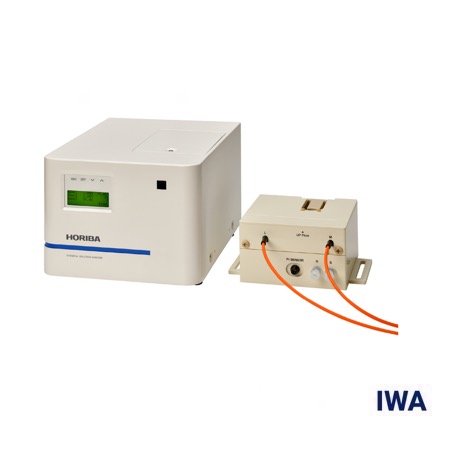
The CS-620F is HORIBA's optical fiber type hot phosphoric acid concentration monitor, designed for real-time concentration management of high-temperature, high-concentration phosphoric acid (H₃PO₄) used in the SiN layer etching process of 3D NAND flash memory semiconductor manufacturing. Using absorption spectroscopy with temperature compensation multivariate analysis through a fiber-optic non-contact cell, it measures H₃PO₄ concentration in the range 85–92 mass% directly in the process circulation line at 140–170 °C — without requiring cooling, pretreatment, or sample dilution. Data updates every 3 seconds enable fast concentration feedback control; the semi-annual background adjustment cycle minimises equipment downtime.
On order
CS-620F, Optical Fiber Type Hot Phosphoric Acid Concentration Monitor, HORIBA
CS-620F
Horiba
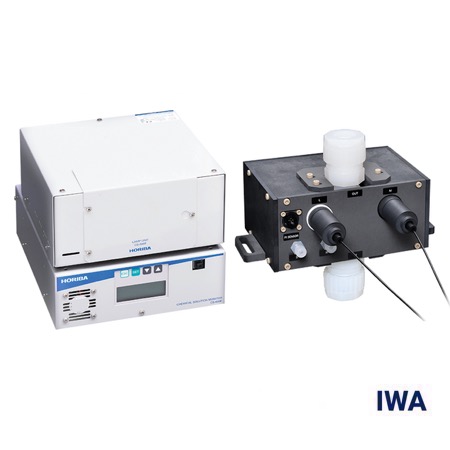
The CS-620F is HORIBA's optical fiber type hot phosphoric acid concentration monitor, purpose-built for real-time concentration management of phosphoric acid (H₃PO₄) in the SiN (silicon nitride) layer etching process used in 3D NAND flash memory semiconductor manufacturing. High-temperature phosphoric acid at 140–170 °C is used at high concentrations (85–92 mass%) in this critical etching step; conventional concentration monitors cannot handle such extreme conditions without cooling systems and sample pretreatment, causing measurement delays that limit feedback control performance. The CS-620F addresses this by using an optical fiber non-contact measurement method — light is transmitted to and from the process circulation line via fiber-optic cables and a PFA sample cell, with no direct contact between the measurement optics and the corrosive hot acid. Absorption spectroscopy with temperature compensation multivariate analysis calculates H₃PO₄ and H₂O concentrations simultaneously, with data updates every 3 seconds enabling fast, real-time feedback control. PFA material at all sample contact points reduces contamination risk; the semi-annual background adjustment cycle minimises equipment downtime. The system comprises three separate units — monitor, lamp unit, and sample cell — connected by a 5 m optical fiber cable.
Key Features CS-620F
- Direct measurement of high-temperature (140–170 °C) and high-concentration (85–92 mass%) phosphoric acid in the process circulation line — no cooling, no pretreatment, no sample dilution required.
- Optical fiber non-contact measurement — fiber-optic transmission to/from PFA sample cell; no direct contact between measurement optics and hot acid; low contamination risk.
- Absorption spectroscopy with temperature compensation multivariate analysis — simultaneous H₃PO₄ and H₂O concentration measurement with ±0.10 mass% repeatability (H₃PO₄).
- 3-second measurement interval with 16-point moving average — fast real-time concentration feedback control.
- Semi-annual background adjustment cycle — significant reduction in equipment downtime vs frequent calibration requirements.
- PFA connection fittings (1" or 3/4") — chemically resistant, low contamination risk at sample contact points.
- Three-unit system (monitor + lamp unit + sample cell) connected by 5 m optical fiber (bend radius R150 mm) — flexible installation in semiconductor process equipment.
- 100–230 V AC single-phase; RS-485; analog output; parallel I/O; contact output.
Applications
The CS-620F is suited to real-time phosphoric acid concentration management in the SiN layer wet etching process for 3D NAND flash memory semiconductor manufacturing — where high-temperature (140–170 °C), high-concentration (85–92 mass%) H₃PO₄ is used in bath circulation systems and precise concentration control is critical for etch selectivity and process consistency.
Installation and Safety Notes
Monitor and lamp unit: install at 20–30 °C, 40–70% RH (no condensation); inclination within ±1°. Sample cell and optical fiber: ambient temperature 20–100 °C; install sample cell so that air bubbles do not remain. Sample temperature: 140–170 °C; avoid temperature fluctuations exceeding ±1 °C/h. Input pressure ≤0.2 MPa (G); pressure fluctuation ≤0.02 MPa. Flow rate 1–30 L/min. Air supply required: 4 mm O.D. quick joint, 0.2 MPa ±0.02 MPa. Power: 100–230 V AC single-phase, 50/60 Hz, ~85 VA (excl. start-up transient). Sudden temperature changes must be avoided.
Technical Specifications
| Measurement principle | Absorption spectroscopy; temperature compensation multivariate analysis |
| Measurement method | Optical fiber non-contact (fiber-optic transmission through PFA sample cell) |
| Sample | H₃PO₄ / H₂O (hot phosphoric acid) |
| H₃PO₄ range / repeatability | 85.00–92.00 mass% / ±0.10 mass%; analog output 85.00–100.00 mass% |
| H₂O range / repeatability | 8.0–15.0 mass% / ±0.3 mass%; analog output 0.0–15.0 mass% |
| Note on repeatability | Max. error from 1-hour average; possible ±0.30 mass% discrepancy between 140 °C and 170 °C measurements of same chemical |
| Measurement interval | Approx. 3 s (minimum); 16-point moving average |
| Sample temperature | 140–170 °C; fluctuation within ±1 °C/h |
| Sample pressure | ≤0.2 MPa (G); fluctuation ≤0.02 MPa |
| Sample flow rate | 1–30 L/min |
| Connection fitting | PFA, 1" or 3/4" |
| Air supply | 4 mm O.D. quick joint; 0.2 MPa ±0.02 MPa (required for operation and purge) |
| Communication | RS-485; analog output; parallel I/O; contact output |
| Power supply | 100–230 V AC, single-phase, 50/60 Hz; ~85 VA (excl. start-up transient) |
| Ambient temperature (monitor/lamp unit) | 20–30 °C; fluctuation within ±1 °C/h; no sudden changes |
| Ambient temperature (optical fiber/sample cell) | 20–100 °C |
| Ambient humidity (monitor/lamp unit) | 40–70% RH (no condensation) |
| Optical fiber | Length 5 m; bend radius R150 mm |
| Monitor dimensions (W × D × H) | 200 × 308 × 78 mm; approx. 3.6 kg |
| Lamp unit dimensions (W × D × H) | 200 × 262 × 100 mm; approx. 2.8 kg |
| Sample cell dimensions (W × D × H) | 240 × 209 × 205 mm; approx. 3.0 kg |
| Manufacturer | HORIBA Advanced Techno Co., Ltd. |
| Brand | Horiba |