Citric acid (ACS reagent grade, ≥99.5%) is a high-purity crystalline dicarboxylic acid used as a buffering agent, chelating agent, and acidifier in analytical chemistry and synthetic applications.
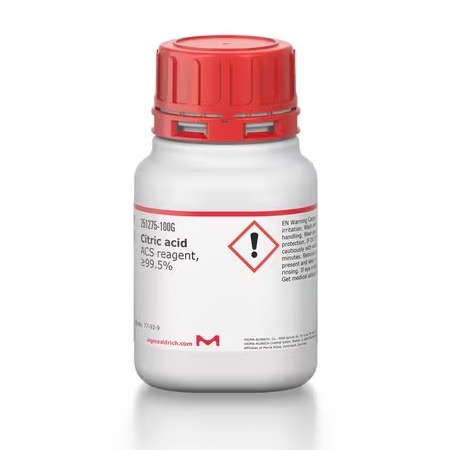
Citric acid (anhydrous) is a versatile organic acid found naturally in citrus fruits. This ACS reagent grade material is characterized by its exceptionally high purity (≥99.5%) and low levels of trace impurities like heavy metals, phosphates, and oxalates, making it suitable for demanding laboratory protocols. In analytical procedures, it is commonly used to prepare buffer solutions (e.g., Citrate Buffer) and as a masking agent to prevent the interference of metal ions through chelation. Its crystalline form ensures stability and ease of weighing for precise stoichiometric preparations.
Advantages
- Meets or exceeds American Chemical Society (ACS) specifications for reagent chemicals.
- High assay (≥99.5%) ensures minimal interference in sensitive analytical methods.
- Excellent solubility in water and alcohol.
- Effective metal-chelating properties for cleaning and stabilizing sensitive solutions.
- Wide range of applications from biochemical research to food and beverage analysis.
Technical specifications
| Catalogue number | 251275 |
| Product name | Citric acid |
| CAS Number | 77-92-9 |
| Molecular Formula | C6H8O7 |
| Molecular Weight | 192.12 g/mol |
| Purity (Assay) | ≥99.5% |
| Grade | ACS Reagent |
| Form | Crystals / Crystalline powder |
| Melting Point | 153–159 °C (lit.) |
| Storage Temperature | Room temperature (15–25 °C) |
| Brand | Merck |