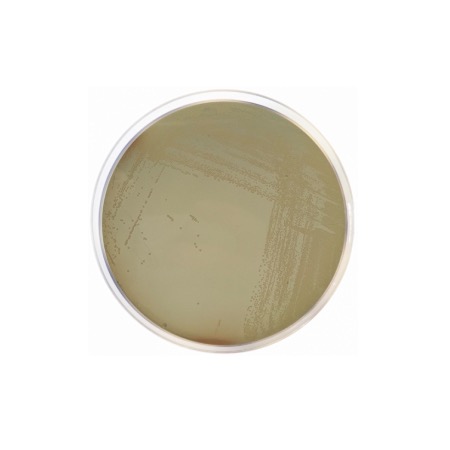
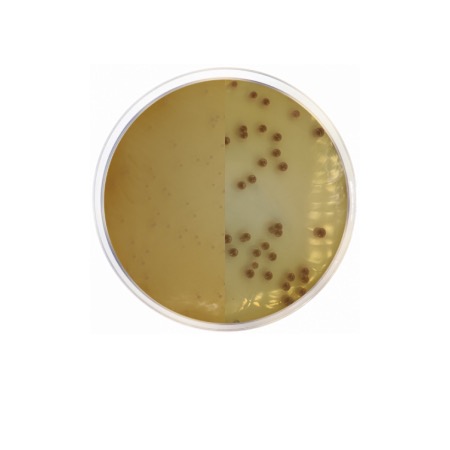
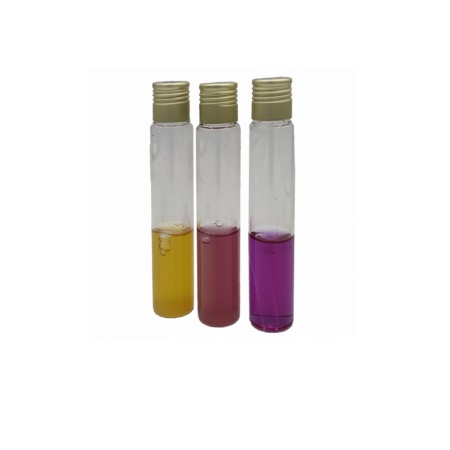
Originally developed by Endo in 1904, this medium differentiates lactose fermenters from non-fermenters without the use of bile salts. The selectivity is achieved through the combination of Sodium Sulfite and Basic Fuchsin, which inhibit the growth of Gram-positive bacteria. Bacteriological Peptone provides the essential nitrogen, vitamins, and minerals for growth, while Lactose is the fermentable carbohydrate. Dipotassium Phosphate serves as a buffering system to maintain pH stability. When lactose is fermented, the resulting aldehydes and acids react with the fuchsin-sulfite complex, turning the colonies red. Escherichia coli produces a particularly intense reaction, forming dark red colonies with a characteristic green metallic sheen (fuchsin luster).
Advantages
- Specific Differentiation: Excellent for distinguishing between coliforms (red colonies) and non-lactose fermenters (colorless colonies).
- Standard Compliance: Recommended by APHA for the examination of water, dairy, and food products.
- Clear Identification: The unique metallic sheen of E. coli allows for rapid presumptive identification on the plate.
- Non-Bile Selectivity: Effective inhibition of Gram-positive flora using a chemical complex rather than bile salts, which can sometimes be less consistent.
- Wide Utility: Used both for the primary isolation of enteric pathogens and as a confirmatory test in water quality analysis.
Technical specifications
| Catalogue number |
1118 |
| Brand |
Condalab |
| Application |
Detection and confirmation of coliforms |
| Typical Composition (g/L) |
Bacteriological Peptone (10.0); Lactose (10.0); Dipotassium Phosphate (3.5); Sodium Sulfite (2.5); Bacteriological Agar (10.0) |
| Final pH (at 25 °C) |
7.5 ± 0.2 |
| Preparation |
36.0 g/L |
| Storage Temperature |
2 – 25 °C (Keep away from light) |
Available packaging options
| 1118 |
500 g plastic bottle |