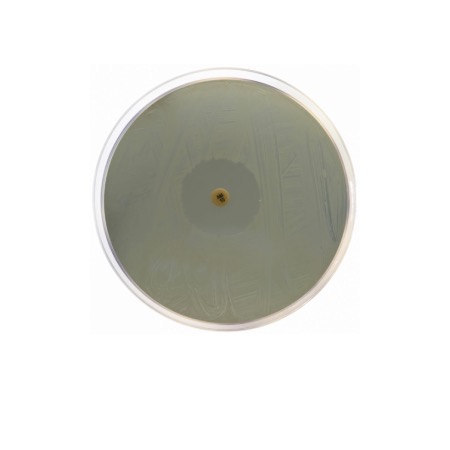
Formulated by King et al., this medium is specifically designed to enhance the production of fluorescein, a yellow-green fluorescent pigment, while suppressing the production of pyocyanin. The Proteose Peptone provides the nitrogen, vitamins, and amino acids necessary for growth. Dipotassium Phosphate serves as a buffering agent and provides a source of phosphorus, which, at specific concentrations, stimulates fluorescein production. Magnesium Sulfate acts as a co-factor that further enhances pigment expression. When Pseudomonas species grow on this medium, they produce pyoverdin, which fluoresces a bright yellow-green under ultraviolet (UV) light (366 nm). This allows for rapid presumptive identification of the genus.
Advantages
- Optimized Pigmentation: Specifically formulated to maximize the recovery of fluorescent pigments, aiding in clear differentiation.
- High Sensitivity: Capable of detecting low levels of Pseudomonas contamination in environmental water and clinical samples.
- Easy Visualization: The contrast of the fluorescent colonies under UV light allows for quick screening of large numbers of plates.
- Standardized Monitoring: Widely used in water quality testing and the pharmaceutical industry for the detection of P. aeruginosa.
- Nutrient Balanced: Supports the growth of most Pseudomonas species while providing the chemical cues needed for secondary metabolite production.
Technical specifications
| Catalogue number |
1053 |
| Brand |
Condalab |
| Application |
Detection of fluorescein-producing Pseudomonas |
| Typical Composition (g/L) |
Proteose Peptone (20.0); Dipotassium Phosphate (1.5); Magnesium Sulfate (1.5); Bacteriological Agar (15.0) |
| Final pH (at 25 °C) |
7.2 ± 0.2 |
| Preparation |
38.0 g/L (Add 10 mL Glycerol) |
| Storage Temperature |
2 – 25 °C |
Available packaging options
| 1053 |
500 g plastic bottle |



.jpg)