Potassium iodide (ACS reagent grade, ≥99.0%) is a high-purity inorganic salt used as a source of iodide in chemical synthesis, redox titrations, and various analytical and biological applications.

Potassium iodide (KI) is a classic reagent in analytical chemistry. This ACS reagent grade product ensures low levels of impurities, such as heavy metals, iron, and iodates, making it ideal for quantitative analysis. It is most commonly used in iodometry, where it acts as a reducing agent to release iodine in the presence of oxidants, which is then titrated with sodium thiosulfate. In biological research, it is used for the preparation of Lugol's solution and as a component in several culture media formulations. Additionally, it serves as a nucleophile in organic synthesis and as a fluorescence quencher in biophysical studies.
Advantages
- Meets or exceeds American Chemical Society (ACS) specifications for analytical reagents.
- High purity (≥99.0%) ensures accuracy in sensitive redox titrations.
- Excellent solubility in water (1.4 kg/L) and glycerol.
- Versatile reagent for environmental monitoring, specifically for the determination of chlorine and dissolved oxygen.
- Stable crystalline form for precise weighing and preparation of standard solutions.
Technical specifications
| Catalogue number | 207969 |
| Product name | Potassium iodide |
| CAS Number | 7681-11-0 |
| Molecular Formula | KI |
| Molecular Weight | 166.00 g/mol |
| Purity (Assay) | ≥99.0% |
| Grade | ACS Reagent |
| Form | Crystalline powder / Granules |
| Melting Point | 681 °C (lit.) |
| Storage Temperature | Room temperature (15–25 °C) |
Available packaging options
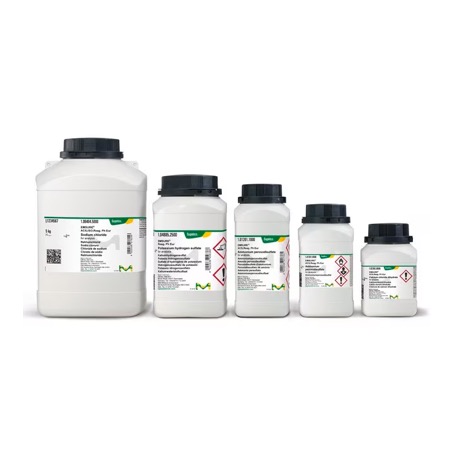
| 207969-100G | 100 g poly bottle |
| 207969-500G | 500 g poly bottle |