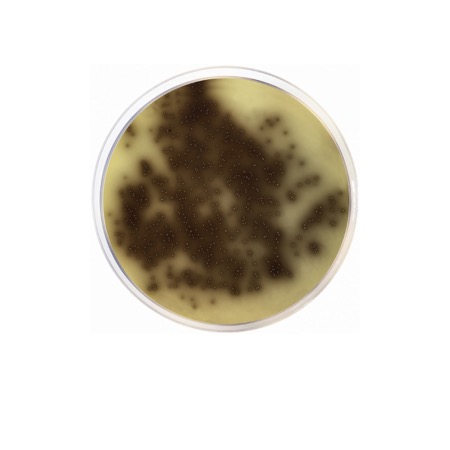
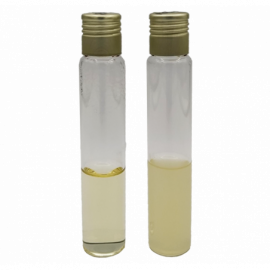
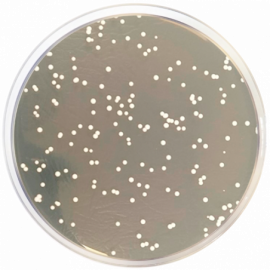
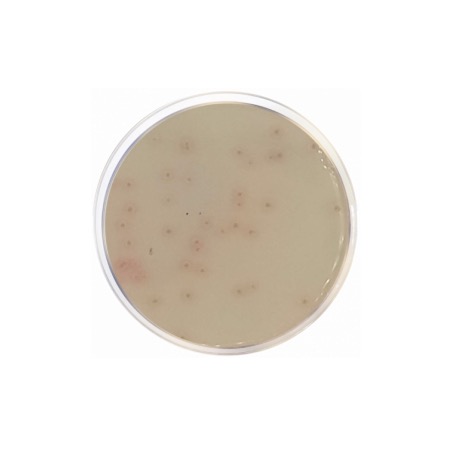
This medium combines the selective properties of bile salts and sodium azide with the differential indicator esculin. Peptone Mixture and Yeast Extract provide the essential nitrogen, vitamins, and minerals required for bacterial growth. Ox Bile (Bile Salts) inhibits the growth of most Gram-positive bacteria, while Sodium Azide suppresses Gram-negative flora. The differentiation is based on the hydrolysis of Esculin. Enterococci are able to hydrolyze esculin into esculetin and dextrose. The esculetin reacts with Ferric Ammonium Citrate in the medium to form a dark brown or black complex, which results in a distinct blackening of the agar around the colonies.
Advantages
- High Selectivity: The dual action of Ox Bile and Sodium Azide ensures the inhibition of non-target organisms, including most Streptococci other than Group D.
- Clear Differentiation: The rapid blackening of the medium provides a definitive visual presumptive identification of Enterococci.
- Clinical and Environmental Utility: Recommended for use in clinical diagnostics and for the analysis of food and water samples.
- Standardized Performance: Consistent results in the recovery of fecal Enterococci, helping to identify fecal contamination in environmental sources.
- Stable Diagnostic Reaction: The ferric citrate complex provides a sharp contrast that remains stable throughout the incubation period.
Technical specifications
| Catalogue number |
1372 |
| Brand |
Condalab |
| Application |
Selective isolation and presumptive identification of Enterococci |
| Typical Composition (g/L) |
Peptone Mixture (20.0); Yeast Extract (5.0); Ox Bile (10.0); Sodium Chloride (5.0); Esculin (1.0); Ferric Ammonium Citrate (0.5); Sodium Azide (0.15); Bacteriological Agar (15.0) |
| Final pH (at 25 °C) |
7.1 ± 0.2 |
| Preparation |
56.65 g/L |
| Storage Temperature |
2 – 25 °C |
Available packaging options
| 1372 |
500 g plastic bottle |