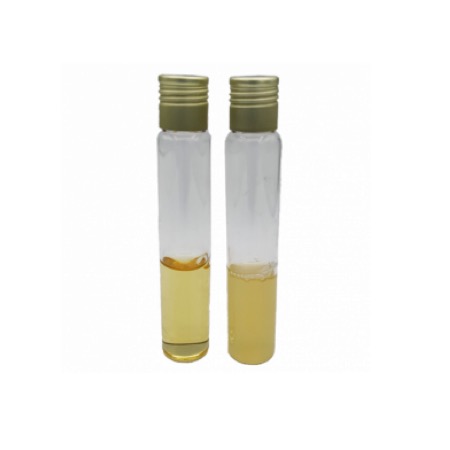
Asparagine Broth is formulated according to standardized methods for the microbiological analysis of water. The medium’s simplicity is its primary selective feature: it contains only L-Asparagine, Dipotassium Phosphate, and Magnesium Sulfate. Because most common water contaminants cannot synthesize all necessary cellular components from asparagine alone, their growth is inhibited. In contrast, Pseudomonas aeruginosa thrives in this environment, often producing a characteristic fluorescent pigment (pyoverdin) that can be observed under ultraviolet (UV) light. This makes the medium an essential tool for monitoring water quality in swimming pools, spas, and environmental sources.
Advantages
- Highly Selective: The minimal nutrient profile prevents the growth of non-target bacteria that require complex organic nitrogen or carbon sources.
- Easy Detection: Facilitates the production of fluorescent pigments, allowing for rapid presumptive identification under 365 nm UV light.
- Standardized Method: Complies with international standards for the detection of P. aeruginosa in water treatment and environmental monitoring.
- Chemically Defined: The precise formulation ensures high reproducibility and eliminates the variability often found in complex peptone-based media.
- Versatile Scale: Can be prepared at single or double strength to accommodate various sample volumes in MPN testing.
Technical specifications
| Catalogue number |
1207 |
| Brand |
Condalab |
| Application |
Enumeration of Pseudomonas aeruginosa in water |
| Typical Composition (g/L) |
DL-Asparagine (3.0); Dipotassium Phosphate (1.0); Magnesium Sulfate (0.5) |
| Final pH (at 25 °C) |
7.0 ± 0.2 |
| Preparation |
12.8 g/L |
| Storage Temperature |
2 – 25 °C |
Available packaging options
| 1207 |
500 g plastic bottle |