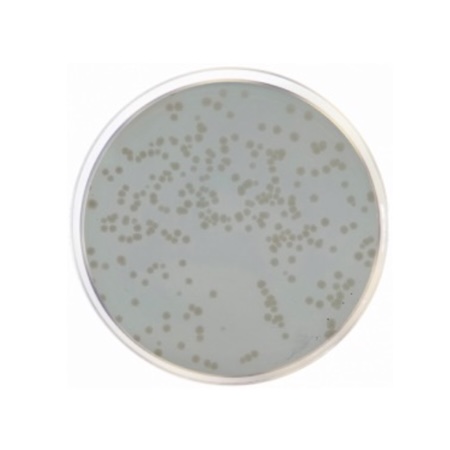
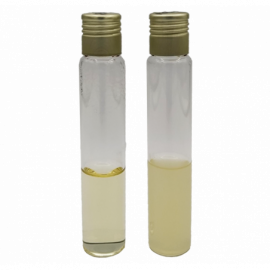
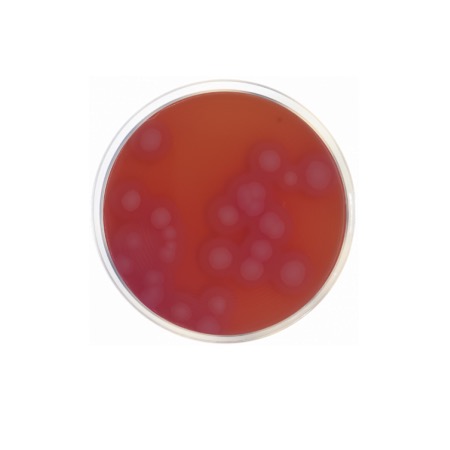
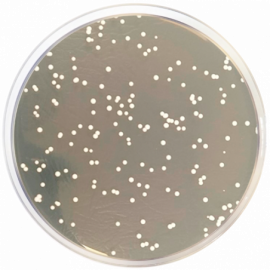
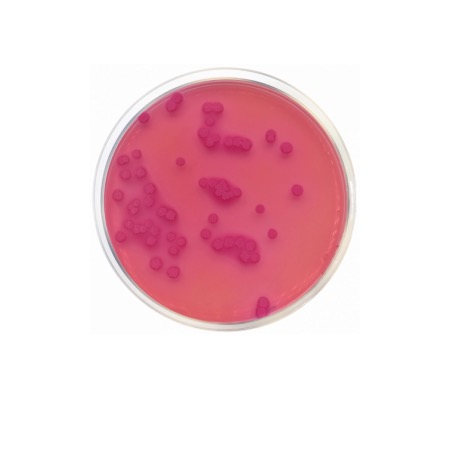
Originally formulated by Leifson, Desoxycholate Agar is designed to inhibit the growth of Gram-positive bacteria while allowing the growth of Gram-negative rods. The selectivity is achieved through the inclusion of Sodium Desoxycholate (at a concentration of 0.1%), which is less inhibitory to enteric pathogens than bile salts. Peptone Mixture provides the nitrogen, vitamins, and minerals required for growth. Lactose is the fermentable carbohydrate, and Neutral Red serves as the pH indicator. When lactose is fermented, the produced acids cause the colonies to turn red or pink and may lead to the precipitation of desoxycholate, appearing as a cloudy zone around the colonies. Non-lactose fermenters, such as Salmonella and Shigella, produce colorless or transparent colonies.
Advantages
- Improved Recovery: The lower concentration of desoxycholate compared to other selective media allows for a better recovery of stressed enteric pathogens.
- Clear Differentiation: Provides a sharp contrast between lactose fermenters (red) and non-fermenters (colorless), simplifying the screening process.
- Standard Application: Recommended for the direct surface plating of clinical specimens and for the "pour plate" method in dairy and water analysis.
- Stable Indicator: Neutral Red provides a reliable and easy-to-read color change in response to acid production.
- Uniformity: Carefully balanced salts (Sodium Citrate and Sodium Chloride) maintain osmotic balance and enhance selectivity.
Technical specifications
| Catalogue number |
1020 |
| Brand |
Condalab |
| Application |
Isolation and differentiation of Enterobacteriaceae |
| Typical Composition (g/L) |
Peptone Mixture (10.0); Lactose (10.0); Sodium Desoxycholate (1.0); Sodium Chloride (5.0); Sodium Citrate (2.0); Neutral Red (0.03); Bacteriological Agar (15.0) |
| Final pH (at 25 °C) |
7.3 ± 0.2 |
| Preparation |
45.0 g/L (Do not autoclave) |
| Storage Temperature |
2 – 25 °C |
Available packaging options
| 1020 |
500 g plastic bottle |